





 VK.com
 Telegram
 Gab
Gab
 Brighteon
 BitChute







Creation Sites
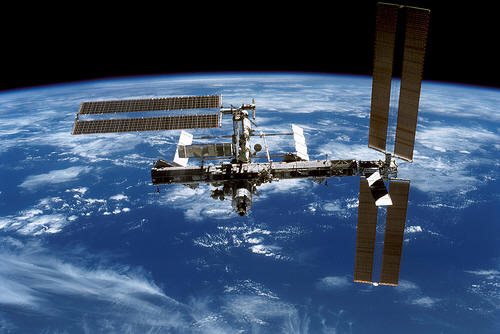
Image credit: International Space Station above Earth (2006) NASA (Public Domain)
Apollo 8 Astronaut Recalls Historic Scripture Reading (Gen. 1) from Space on Christmas Eve 1968 & Censoredscience (suppressed science). Listen to the two audio lectures: A Christian Philosophy of Science (Parts 1 thru 3) & A Survey of Genesis - Lectures 1 thru 10, a seminary course by Dr. Robert A. Morey
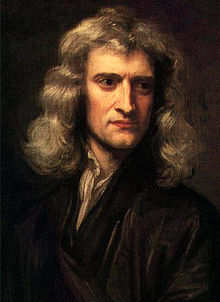
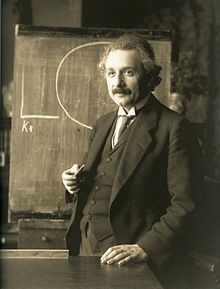
Image credit: Sir Isaac Newton (1642-1727) by Godfrey Kneller (1689) & Albert Einstein (1879-1955) in 1921
What is science?
Many individuals have a misunderstanding of science. Science does not discover truth--you cannot discover absolute truth, its theories are relative to the surrounding culture and times. What secular humanists call “science” is actually 99% a mixture of philosophy and religion. When someone says, I believe in science,” he actually means in a religion called “scientism”—in other words, it means what scientists voted for in Western culture. Yes, “science” is relative to its cultural context—that is, it has always followed the philosophic worldview of society. For example, Isaac Newton’s worldview of “immutable mechanical laws” was based on his philosophical adherence to rationalism and Albert Einstein‘s “theory of relativity” which was based on his Talmudic heritage and the philosophy of Spinoza (faith-based religious dogmas from Spinoza’s pantheistic religion, unrestricted determinism, etc.).
It should be noted that Einstein did not believe in moral or physical relativism and believed that science and religions were compatible. Quantum Mechanics was another philosophical shift in science—Heisenberg demonstrated that Einstein’s laws did not work when applied to sub-atomic elements, the “principle of indeterminacy”. In the 1960’s, Existentialism (all is meaningless, everything is relative) was promoted in the schools and adopted by many scientists, which has now been replaced by Eastern idealism (reality is “mind” and denies the existence of “matter”---that is, Taoism and Buddhism (HTML) have become the popular religious frame work of physics). Leucippus, Democritus and Epicurus believed the universe was composed of “atoms” that made up four elements [Earth, Air, Fire and Water where the psychological theory of the four basic personality types came from (Sanguine, Phlegmatic, Choleric, Melancholic)] and could not be observed by the five senses, thus accepted by faith alone (the first true materialist)—Atomism was rejected by Aristotle. Materialism was resurrected in the 17th century renaissance and thus Atomism is taught in high school classes today; a religious myth from ancient Greece. The Greeks never produced a philosophy or worldview that was believable or livable.
One of the big problems with one application of philosophy erroneously called the scientific method is induction [(this is actually a problem for all forms of empiricism (experience).] (An inductive argument is merely probable or improbable whereas a deductive argument is either valid or invalid--induction, which argues from the particular to the general, is always a logical fallacy.) Observation or induction is just one belief among many different philosophies of science and it is called "realism" and was invented by the philosophy of Logical Positivism. When humanist scientists try to determine moral absolutes or determine if the universe has a beginning they have crossed over to metaphysics--they cannot answer those questions.
In the book/biography entitled Einstein: The Life and Times by Ronald W. Clark, Avon Books, 1971, 504 (also, see pages viii and ix, The Philosophy of Science And Belief in God by Dr. Gordon H. Clark), Albert Einstein in a conversation with famous physicist Dr. Chaim Tschernowitz stated:
..."Suddenly [Einstein] lifted his head, looked upward at the clear skies, and said: 'We know nothig about it at all. All our knowlege is but the knowledge of schoolchildren.' " 'Do you think,' I asked, 'that we will ever probe the secret?' 'Possibly,' he said with a movement of his shoulders, 'we shall know a little more than we do now. But the real nature of things, that we shall never know, never.' "
Albert Einstein also declared that his theory was false--he said that it would be a better approximation to the truth than Newton's. English mathematician, logician, and philosopher Bertrand Russell made the observation that scientific laws are based on fallacious arguments. In other words, induction, experimentation, observation, or experience cannot be used to determine truth, but only through revealed propositions. The utility of science can be defended even while asserting its falsity. For example, the germ theory was proved false with respect to milk fever, but was useful in curing cows. (See The Delusions of Atheists and Was Albert Einstein an Atheist? & 50 Nobel Laureates and Other Great Scientists Who Believe in GOD.)
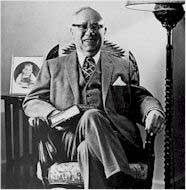 Dr. Gordon H. Clark (8/31/1902--04/09/1985--undergraduate and doctorate from University of
Pennsylvania and he studied at Sorbonne), one of your most brilliant philosophers in the 20th-century, in his book entitled
The Philosophy of Science And Belief in God,
Dr. Clark stated on page xvi, "...The simplest things are the hardest. Nothing is more difficult to explain than the simple phenonmenon
of a marble rolling across a table. And it was one of the world's best modern scientists who admitted that he was completely baffled by the fact that
when one picks up one end of a pencil, the other end comes along with it.....These simple problems are basic; therefore, they are very old. Men of other
ages have wrestled with them. And in general it may be said that the superstructure of science in any age depends on how a marble is thought to roll or
a stone to fall." (Larry Laudan has documented how Western science has radically changed its view of reality over thirty times--see
A Christian Student's Survival Guide
by Dr. Robert A. Morey, who studied under Dr. Gordon H. Clark, for a more detailed explanation on this subject.)
Dr. Gordon H. Clark (8/31/1902--04/09/1985--undergraduate and doctorate from University of
Pennsylvania and he studied at Sorbonne), one of your most brilliant philosophers in the 20th-century, in his book entitled
The Philosophy of Science And Belief in God,
Dr. Clark stated on page xvi, "...The simplest things are the hardest. Nothing is more difficult to explain than the simple phenonmenon
of a marble rolling across a table. And it was one of the world's best modern scientists who admitted that he was completely baffled by the fact that
when one picks up one end of a pencil, the other end comes along with it.....These simple problems are basic; therefore, they are very old. Men of other
ages have wrestled with them. And in general it may be said that the superstructure of science in any age depends on how a marble is thought to roll or
a stone to fall." (Larry Laudan has documented how Western science has radically changed its view of reality over thirty times--see
A Christian Student's Survival Guide
by Dr. Robert A. Morey, who studied under Dr. Gordon H. Clark, for a more detailed explanation on this subject.)
Note: Creationists believe in variation, mutation and natural selection in living things such as speciation, which can occur within a few generations--however, this is really "adaptation". It is variation within a kind. In other words, dogs remain dogs, frogs remain frogs, and horses remain horses. What creationists call "evolution" is a hypothetical philosophy that single-celled animals changed by mutation and natural selection into reptiles, birds, mammals and people (the molecules-to-man concept) over millions of years. Evolutionists should not use the same word (evolution) to describe "adaptation"--this is the fallacy of equivocation. Creationists reject that small random mutations produce new genetic information for changes to occur in animals, which would require genetic errors over millions of generations. The problem is that these sort of changes have never been observed. Variation and natural selection do not produce new genetic information, but only rearrange or remove the existing information--mutations do not generate new genetic information. They usually destroy some of the existing information. Furthermore, the innumerable transitional forms expected in the fossil record are missing.
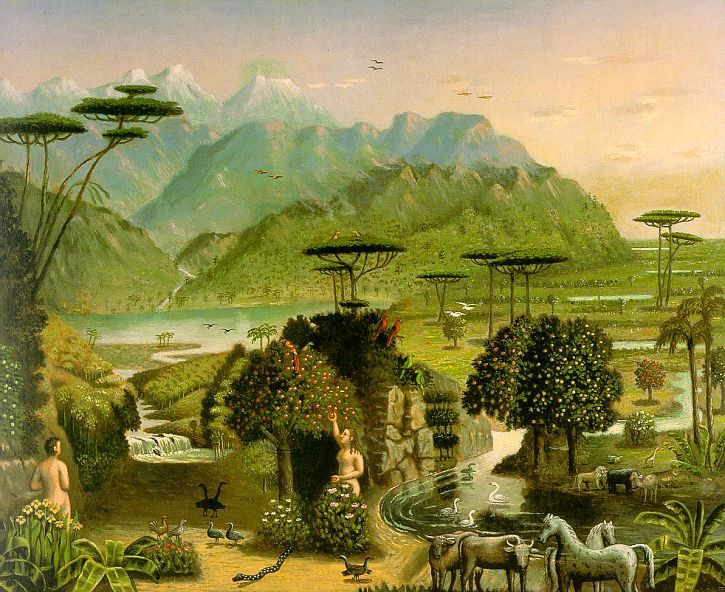
Image credit: Garden of Eden by Erastus Salisbury Field (1805-1900) in 1860 (Public Domain)
Was there physical death, pain, decay and animals killing each other before the Pre-Fall world?
God has declared His creation to be “good” (Genesis 1:4, 10, 12, 18, 21, 25)—evil was not God’s original creation. Because God declares his creation be “very good” (Genesis 1:31), He is not the author of evil in the sense He created it. So nothing God created is evil intrinsically—in other words, the material and spiritual universe that exists is intrinsically good in terms of its metaphysical existence. As a result, pain, suffering, decay and death should not be viewed as “evil”—they were present in the pre-Fall world. Fires caused by lightening, animals killing each other and eating plants for food and the body’s natural makeup with the inherent quality to know his physical limitation such as burning your hand if it is put in a fire is part of the natural process established by God Himself. Physical death was a part of creation (Pre-Fall world) and should not be viewed as “evil.” Did not God command Adam to ‘tend and keep’ the garden (Genesis 2:15) because the leaves fell off as vegetation died? The death of animals and plants is not a moral evil due to sin. After the fall of Man, he was no longer vegetarian (see Genesis 4:4 that shows Abel sacrificing animals to the Lord). Animals outside the Garden were not vegetarian before the fall-- Genesis 1:29-30 never uses the word only in the verses). When God created the world, it began to perish like a garment (Psalm 102:25-27; Hebrews 1:10-12). Thus Adam had an earthly, corruptible and mortal body (I Corinthians 15:47-50). After the Fall, Adam introduced mankind to the penal consequence (punishment) for sin.
Many scholars might object by quoting Romans 5:12: “Therefore, just as through one man sin centered into the world, and death through sin, and so death spread to all men, because all sinned.” Dr. Morey contends that the phrase “sin entered the world” is a parallel expression for the phrase “spread to all men,” and thus the usage of the word “world” is in reference to mankind and not the universe. Dr. Morey further concludes that since sin existed before the fall of man (angels fell into sin) and came to earth via Satan, Romans 5 is talking about death being introduced to mankind as the penal consequence of sin. To quote Charles Hodge:
"It is hardly necessary to remark, that kosmos does not here mean the universe. Sin existed before the fall of Adam. It can only mean the world of mankind. Sin entered the world; it invaded the race…It means that the world, kosmon, mankind, became sinners; because this clause is explained by saying, all sinned…That the death here spoken of includes all penal evil, death, spiritual and eternal, as well as the dissolution of the body, is evident." [See Charles Hodge, “Commentary on the Epistle to the Romans,” in The Sage Digital Library (Albany, Oregon: Sage Software, 1995, 227, 229.)]
Man was intrinsically good before the Fall and became evil (sinful) after the fall in his nature (Luke 11:13). Man lost his innate knowledge of God, himself and the world and now produces idolatry and wickedness (Romans 3:10-18; I Cor. 2:14). Pain, suffering and death in humanity became the penal punishments for sin (Genesis 3:16-19) and prior to the Fall, death, pain, and suffering were part of the natural process of God’s original creation. Now the whole creation is cursed (Genesis 3:17; Romans 8:20-23) and “…the whole creation groans and suffers the pains childbirth together until now” (Romans 8:22). Evil is not eternal, but is a finite part of the world God made and thus there is not an eternal conflict between good and evil. It should be mentioned that the phrase “Garden” in Genesis comes from a Persian word that meant a zoology park—yes, Adam and Eve were protected from the nasty animals outside of this protected park, which had walls and gates. The Persians would create these zoology parks and bring exotic animals into them. The reason Moses used the Persian word "garden" was to point out that man was placed in a protected zoology park were only domesticated animals were, not dinosaurs and other dangerous animals. The International Standard Bible Encyclopedia comments:
The Arabic jannah (diminutive, jannainah), Like the Hebrew Heb: gannah, literally, "a covered or hidden place," denotes in the mind of the dweller in the East something more than the ordinary garden. Gardens in Biblical times, such as are frequently referred to in Semitic literature, were usually walled enclosures, as the name indicates (Lam 2:6 the American Revised Version, margin), in which there were paths winding in and out among shade and fruit trees, canals of running water, fountains, sweet-smelling herbs, aromatic blossoms and convenient arbors in which to sit and enjoy the effect. These gardens are mentioned in Gen 2 and 3; 13:10; Song 4:12-16; Eccl 2:5,6; Ezek 28:13; 31:8,9; 36:35; Joel 2:3. Ancient Babylonian, Assyrian and Egyptian records show the fondness of the rulers of these countries for gardens laid out on a grand scale and planted with the rarest trees and plants. The drawings made by the ancients of their gardens leave no doubt about their general features and their correspondence with Biblical gardens.
This is why it is absurd to assume that Adam named all the animals, fish and insects on the earth (Gen. 2:10)—Adam only named the domesticated animals God brought to them, which was part of his original creation mandate.

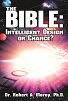
[For further information on this topic see A Survey of Genesis CD series, The Bible, Natural Theology And Natural Law: Conflict Or Compromise?, A Christian Student's Survival Guide (6 x 9), order from Xulon Press,(both books have a detailed chapter on the Biblical Philosophy of Science and Creation Ex Nihilo), The Philosophy of Science CD series and The Bible: Intelligent Design or Chance? Chance? by Dr. Robert A. Morey. CDs mentioned above can be purchased from Faith Defenders store located at (faithdefenders.com). The Philosophy of Science (book) by Dr. Gordon H. Clark (www.trinityfoundation.org ) and Studies in Genesis One by Edward J. Young (www.lifewaystores.com)—ISBN#0875525504 are great books.]
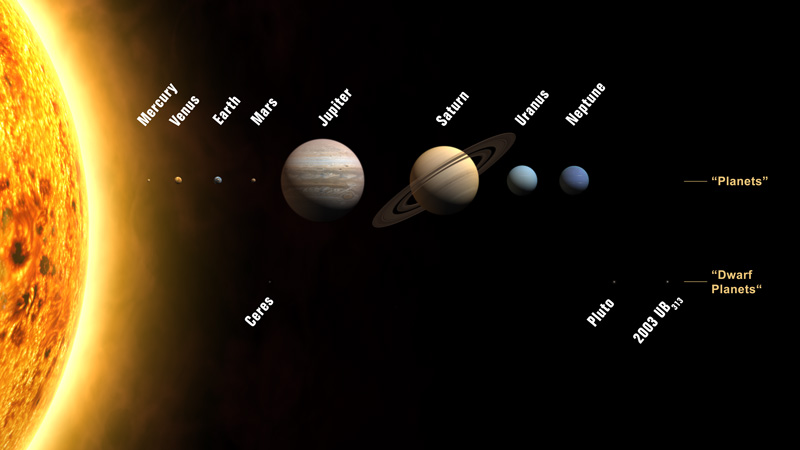
Image Credit: International Astronomical Society (Fair Use)
How should the Days in the Book of Genesis be interpreted?
Dr. Robert A. Morey, a Hebrew and Greek scholar and young earth creationist, explains and clarifies how the Book of Genesis should be interpreted and why many young earth creationists should not be alarmed or confused when someone states the tha universe is billions of years old. God created a mature universe ex nihilo with apparent old age. The Hebrew word “created” in Gen. 1:1 means that the universe was created by God without using any pre-existing eternal materials whatsoever in 6 literal 24 hour days according to the Hebrew meaning of the word “yom” when it is modified by a number such as the “first day” always meant a literal day and thus an apparent old age of the universe and earth would not contradict the Bible; in other words, dating methods, which are constantly changing, that indicate millions or billions of years should not be a concern to creationists. Don’t forget that time and space were created by God and even if there are gaps in the genealogy record in the Bible, which Hebrew writers would do in addition to rounding off numbers, Adam and Eve would not have been created more than 10,000 years ago. Don't forget we are seeing a mature universe created by God. If Adam died one day after God created him, an autopsy would reveal he was 16 years old; however, he was only one day old! Also, Adam and Eve were created instantaneously and were not apes transformed into humans; the Bible is emphatically clear: “man became a living being”, not “a living being became man” ( the Adamic Humanoid Theory is a serious heresy).
Purpose of science?
Theistic science is man's fallible attempt to understand the purpose and meaning of things and to use this for the glory of God. Man is then to take dominion over it (Genesis 1:26) to better mankind. Humanistic science has no basis--they just have their human reason, empiricism, fideism, etc. Humanistic science cannot distinguish between evil and good. Without God science has no foundation. And remember God created the universe with apparent old age.

Image credit: Galileo in front of a Roman Inquisition by Cristiano Banti (1857)--Public Domain
Historical note: The condemnation of Galileo Galilei (1564 -1642) by the Roman Catholic Church for his adoption of the heliocentric model of the universe was not "science vs. religion", but "science vs. science". It was "Aristotelian" science (a geocentric model of the universe) vs. "Copernicus" science (a heliocentric model of the universe).




Sir John Lennon was a Darwin Doubter & From the Grave: John Lennon on a TV Interview Deconstructs the Overpopulation Myth & Creation Ministries International has 15 Questions for Evolutionists & read the Journal of Creation 2012, Vol. 26, Issue 1 online (college and high school science students should subscribe to this magazine).
This was in an interview with Playboy, one of the last he gave and reprinted in a book by journalist David Sheff, All We Are Saying: The Last Major Interview with John Lennon and Yoko Ono (St. Martin's Griffin, 2000):
Nor do I think we came from monkeys, by the way... That's another piece of garbage. What the hell's it based on? We couldn't've come from anything--fish, maybe, but not monkeys. I don't believe in the evolution of fish to monkeys to men. Why aren't monkeys changing into men now? It's absolute garbage. It's absolutely irrational garbage, as mad as the ones who believe the world was made only four thousand years ago, the fundamentalists. That and the monkey thing are both as insane as the apes standing up suddenly. The early men are always drawn like apes, right? Because that fits in the theory we have been living with since Darwin. I don't buy that monkey business. [Singing] "Too much monkey business..." [Laughing] I don't buy it. I've got no basis for it and no theory to offer, I just don't buy it. Something other than that. Something simpler. I don't buy anything other than "It always was and ever shall be." I can't conceive of anything less or more. The other theories change all the time. They set up these idols and then they knock them down. It keeps all the old professors happy in the university. It gives them something to do. I don't know if there's any harm in it except they ram it down everybody's throat. Everything they told me as a kid has already been disproved by the same type of "experts" who made them up in the first place. There.
John Lennon laughed at what he regarded as the ludicrousness of Darwinian theory.
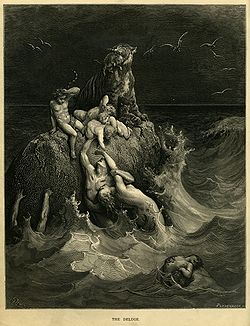
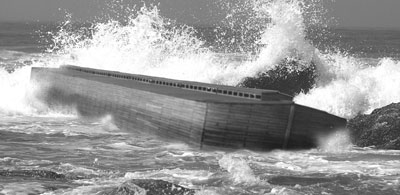
Image credit: The Deluge by Gustave Dore in 1866 & Noah's Ark (Global Flood approx. 2348 B.C.), Public Domain.
 List of Creation Sites
-
Answers in Genesis (The Creation Museum opened in June 2007, which is located near Cincinnati, Ohio.) They publish Answers Magazine -- Answers in Genesis has constructed a full-scale Noah's Ark. It is a $150 million dollar theme park called "Ark Encounter" built on a 800-acre site in Williamstown, KY.
-
Creation Ministries International -- Journal of Creation quarterly magazine is recommended for college science majors and scientists (the magazine is more technical). The other magazine offered is Creation Magazine.
- Institute for Creation Research -- They have a Creation Museum located in North Santee, CA --I recommend their tract entitled Have You Been Brainwashed? by Dr. Duane T. Gish.
- The Creation Club
Points of Origins--Dr. G.C. Jackson is highly recommended for speaking engagements at colleges and universities on the issue of evolution. - Creation Worldview Ministries -- in English & Russian.
- Dive Interactive Education -- Dr. David Shormann [B.S. in Aerospace Engineering, M.S. Marine Chemistry (University of Texas) and PhD Aquatic Science from Texas A & M].
- Faith Defenders--this is not a creation site per se; however, there are two excellent lectures: A Christian Philosophy of Science (Parts 1 thru 3) & A Survey of Genesis - Lectures 1 thru 10, a seminary course by Dr. Robert A. Morey
- The Trinity Foundation -- The Trinity Foundation is not a creation site; however, the site has republished an excellent book entitled Philosophy of Science by Dr. Gordon H. Clark. Also, see Collections 5 & 8 on MP3 link for lectures on the philosophy of science.
- Exclusive 2009 Buzz Aldrin Interview: There's A Pyramid On Mars! -- Note: Most of NASA's work is for military purposes and highly classified. So, probably the Apollo 1 used to land on the moon that the world saw was probably not the acutal Apollo 1 used because of security reasons. The U.S.A. keeps its advanced aircrafts secret.